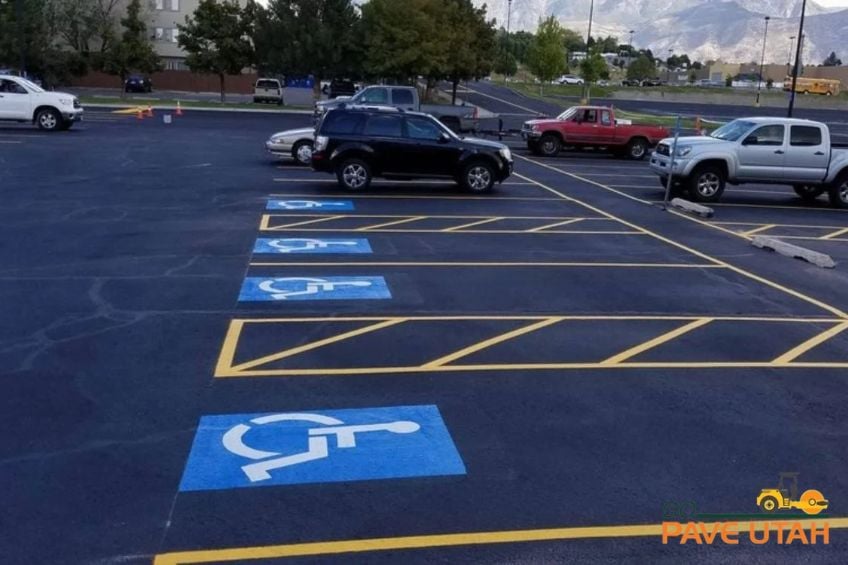
A commercial parking lot can have clearly marked accessible parking spaces and still present challenges for people using wheelchairs, walkers, or other mobility devices. Cracked asphalt, uneven surfaces, deteriorating pavement, and poorly maintained transitions can all affect how easily someone moves from a parking space to a building entrance.
For Utah property managers and commercial property owners, ADA parking lot accessibility involves more than maintaining visible signs and pavement markings. The condition of the pavement itself plays an important role in keeping accessible areas usable. As colder weather approaches, evaluating existing asphalt and concrete conditions can help identify problems that deserve attention. Working with Go Pave Utah can help commercial properties address pavement deterioration as part of ongoing accessibility and asphalt maintenance efforts.
Accessible parking spaces and access aisles must provide more than adequate dimensions and proper markings. Their surfaces must also meet applicable accessibility requirements.
According to the U.S. Department of Justice's ADA guidance on accessible parking, accessible parking spaces and access aisles must have firm, stable, and slip-resistant surfaces, with slopes limited to the applicable standards.
For commercial properties, this makes pavement condition an important part of accessibility evaluations. Asphalt that has developed depressions, significant cracking, or uneven areas may affect how easily mobility devices move across the surface. Even when a parking space was originally constructed to meet accessibility requirements, deterioration over time can change its condition.
The route between an accessible parking space and a building entrance often includes several different surfaces. Asphalt parking areas may connect to concrete sidewalks, curb ramps, or entrance landings. Each transition deserves attention because changes in elevation can make movement more difficult for people using mobility devices.
Property managers should watch for conditions such as:
These conditions do not automatically establish an ADA violation, but they can indicate areas that need further evaluation. Understanding the location and extent of deterioration helps determine whether asphalt repair, concrete repair, or another corrective measure may be appropriate.
A commercial parking lot may have been designed with accessibility in mind, but pavement conditions do not remain unchanged indefinitely. Repeated vehicle loading, moisture exposure, settlement, and general wear can gradually affect asphalt and concrete surfaces.
This is particularly relevant for Utah commercial properties, where seasonal temperature changes and freezing conditions can contribute to deterioration in already damaged areas. Cracks may widen, weakened edges may break apart, and uneven surfaces may become more noticeable.
Routine asphalt maintenance helps property managers recognize these changes before assuming that existing accessible parking areas remain in the same condition as when they were installed. Evaluating pavement condition alongside markings, access aisles, and pedestrian connections provides a more complete picture of accessibility.
ADA accessibility should not be treated as a one-time construction or striping requirement. Commercial properties experience changing traffic demands, pavement wear, and environmental exposure that can affect how accessible areas perform.
For Utah property managers, reviewing accessible parking spaces, curb ramps, and connecting routes during regular property inspections can help identify deterioration that may require professional attention. The appropriate response depends on the condition of the surface and the applicable accessibility standards.
Working with Go Pave Utah can help commercial property owners evaluate asphalt and concrete deterioration, identify areas where repairs may be needed, and determine appropriate pavement maintenance solutions.
Maintaining accessible parking is about more than preserving designated spaces. It means paying attention to the surfaces people depend on every day and addressing pavement conditions that may interfere with access to a commercial property.