Concrete may look like one solid surface, but the lines running through commercial slabs, walkways, and other flatwork are there for a reason. Concrete naturally changes dimension as it dries and responds to temperature and moisture conditions. Joints help accommodate or control that movement and, depending on the type of joint, can help determine where cracking occurs.
For Utah property managers, those joints deserve attention during commercial concrete maintenance. When deterioration develops at or around a joint, what appears to be a small line in the concrete can become an important indicator of how the surrounding surface is performing. Go Pave Utah works with commercial properties to evaluate concrete conditions and determine when maintenance or repair should be considered.
Not every joint performs exactly the same function. The American Concrete Institute identifies several types, including contraction, isolation, expansion, and construction joints. A contraction joint, for example, creates a weakened plane intended to regulate where cracking caused by dimensional changes occurs. Isolation and expansion joints provide separation that allows movement between sections of concrete.
This means a joint is not simply a decorative groove cut into a slab. Joint type, placement, spacing, and construction are part of how a concrete surface manages movement. When evaluating commercial concrete, property managers should consider the joints as part of the overall system rather than focusing only on cracks appearing elsewhere.
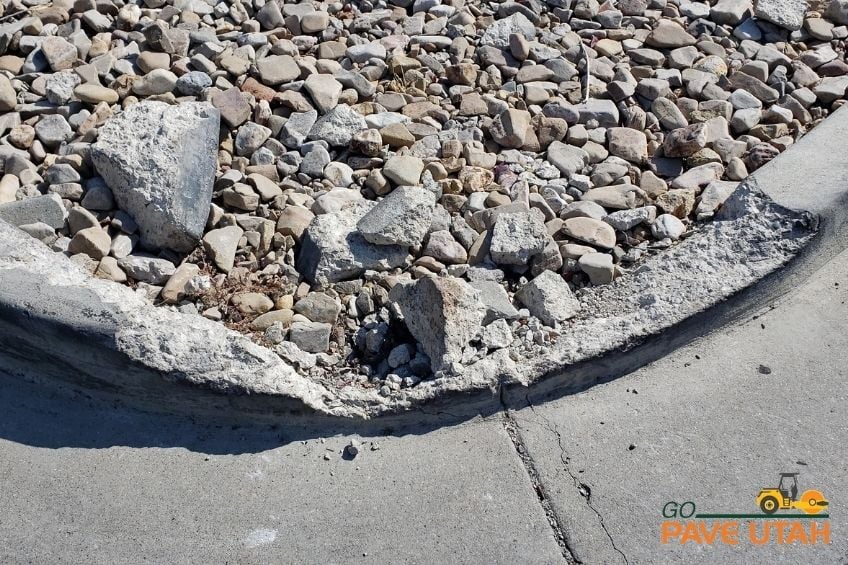
Joints are intentional interruptions in an otherwise continuous concrete surface, and their condition can change over time. Joint edges may chip or spall, joint material can deteriorate, and openings may allow water and debris to collect. These changes can affect how the area performs and may contribute to additional deterioration around the joint.
That is particularly worth watching on commercial concrete in Utah, where moisture and seasonal temperature changes can place additional stress on exposed surfaces. A deteriorating joint does not automatically mean the surrounding slab has failed, but damaged edges, widening openings, or cracking extending away from the joint can signal that the area deserves a closer look. Evaluating the joint along with the surrounding concrete provides a better picture than treating the visible damage as an isolated cosmetic problem.
Property managers do not need to diagnose concrete engineering problems themselves, but routine observations can reveal when a joint or the surrounding concrete has changed. Warning signs can include:
The pattern matters. A small isolated chip is different from deterioration occurring repeatedly along a heavily traveled section of concrete. Vehicle loads, drainage, surrounding pavement conditions, and the location of the slab can all provide useful context when determining what may be happening.
October gives Utah property managers an opportunity to look closely at concrete conditions as seasonal temperatures begin changing. Rather than waiting until damaged joints or surrounding cracks become more noticeable, property managers can include these areas in regular property inspections.
That does not mean every deteriorated joint requires the same response. Some conditions may involve maintenance around the joint, while damaged concrete may require commercial concrete repair. The goal is to understand what is happening before choosing a solution.
Working with Go Pave Utah can help property managers evaluate deteriorating commercial concrete, identify areas that warrant attention, and determine an appropriate repair approach. Concrete joints may occupy only a small portion of a property’s flatwork, but their condition can provide valuable information about the concrete surrounding them.