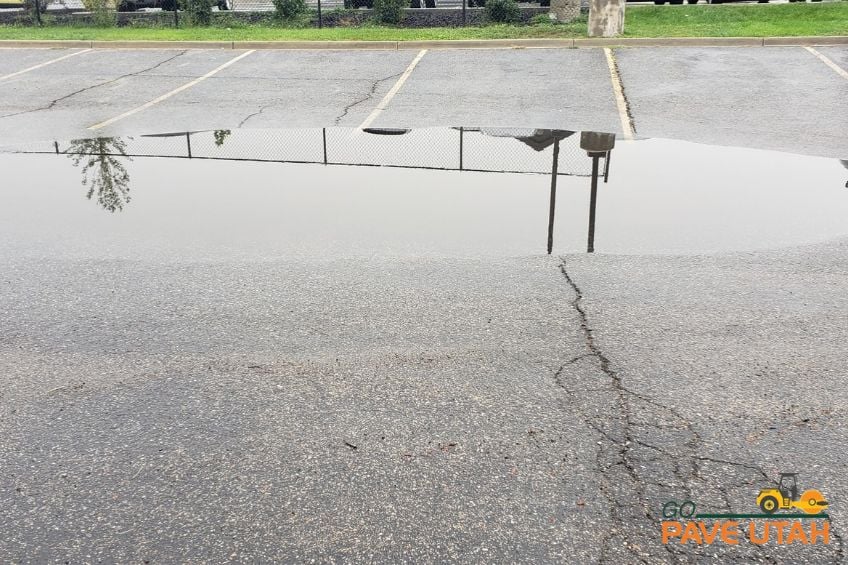
After a Utah rainstorm, most of a commercial parking lot may dry quickly while one stubborn puddle sticks around. It is easy to blame the water, wait for it to disappear, and move on. But sometimes the puddle is not the real problem. It is simply making a low spot in the pavement easier to see.
For property managers and commercial property owners, depressions and uneven areas can provide useful clues about pavement condition. A low spot may develop for several reasons, and determining why the surface has changed can help identify whether asphalt repair should be considered. Go Pave Utah works with commercial properties throughout Utah to evaluate pavement problems and determine an appropriate approach.
Commercial parking lots are graded so water can move toward intended drainage areas rather than remain on the pavement. When water consistently collects somewhere it did not before, the surface may no longer have the same profile it once did.
A low area can become easier to recognize after rain, irrigation, or snowmelt. Property managers may notice:
The water provides a useful visual clue, but the next question is why the pavement has become lower than the surrounding surface.
A depression can develop for different reasons, which is why automatically filling or covering the area may not address what is happening. Settlement beneath the pavement, changes in underlying support, repeated vehicle loading, or problems with the original pavement profile can contribute to uneven areas.
Location can provide additional context. A depression in a heavily traveled drive aisle may experience different stresses than one beside a drain or near the edge of the parking lot. The surrounding pavement matters too. Cracking, movement, rutting, or deterioration around the depression can help provide a broader picture of the area's condition.
Commercial parking lots rarely experience perfectly even traffic. Delivery trucks, garbage trucks, service vehicles, and other heavy equipment often follow the same routes and stop or maneuver in the same places.
That makes several locations worth watching:
If a low spot develops where heavy vehicles repeatedly travel or maneuver, the traffic pattern should be considered when the pavement is evaluated. The visible depression may be only one part of the story.
Standing water does not automatically explain why a depression formed, but it can make an uneven surface impossible to ignore. Water that repeatedly remains in a low area can also find its way into cracks and deteriorated pavement nearby.
Utah's changing seasonal conditions make these areas particularly noticeable as properties move from fall rain toward colder weather. Instead of viewing every recurring puddle strictly as a drainage problem, property managers can use it as a reason to inspect the pavement itself. If the asphalt has settled, cracked, or changed shape, the condition may warrant more than simply waiting for the water to evaporate.
The right response depends on what caused the depression and what condition the surrounding pavement is in. Some areas may require localized asphalt patching or repair, while broader settlement or recurring deformation may require a more detailed evaluation.
Go Pave Utah can evaluate low spots, cracking, deteriorated asphalt, and other pavement concerns on Utah commercial properties. Looking at the location, traffic demands, drainage, surrounding pavement, and visible damage helps determine what type of repair may be appropriate.
A puddle may disappear after the weather clears. If the pavement underneath it has changed, however, the low spot will still be there waiting for the next storm to point it out.